ANKLE MOBILITY
Ankle mobility: get the knee over the toes without the arch collapsing.
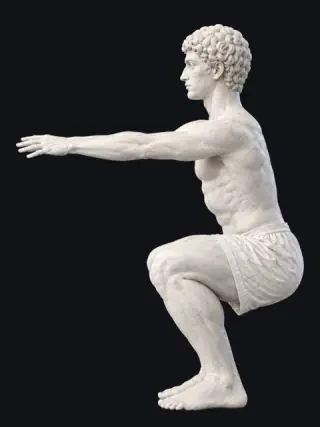
Good ankle mobility lets the knee travel forward over the toes with the heel down and the arch up. Test it with the knee-to-wall test, then build it with calf stretches, knee-over-toe rocks and slow deep squats, feet pointing straight. If the arch collapses to find range, the range is borrowed, so train the foot too.
By Muhammed Cam, founder · Updated
Where it starts · Shoes
Shoes turned your feet out.
Shoes with a raised heel keep the calf short for years, and turned-out feet let you cheat the range. Both are part of the first leak.
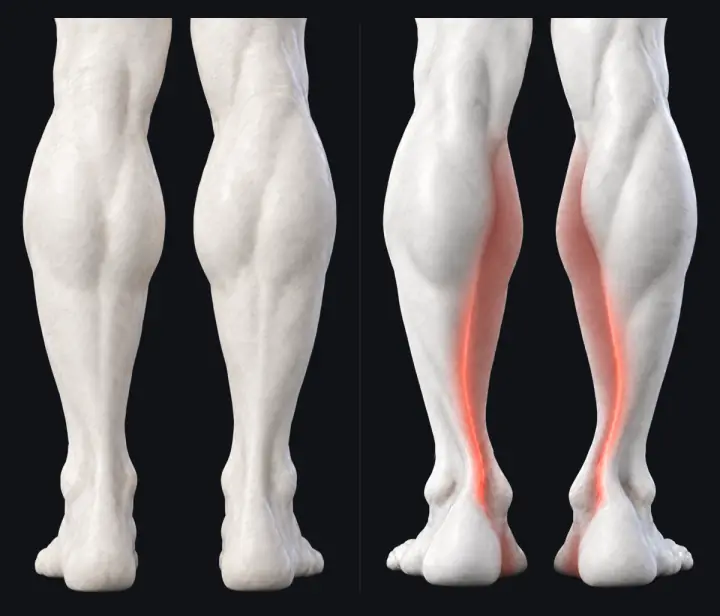
- Working
- Problem: tight or weak
The fix: Feet forward. Point them straight. Wake the arch.
How do I test my ankle mobility?
The knee-to-wall test. Kneel facing a wall with one foot flat, toes about a hand-width (around 10 cm or 4 inches) from the wall. Keeping the heel down, push the knee forward to touch the wall. Move the foot back until you can only just touch.
Compare sides. Then do it again watching the arch. If the arch collapses or the knee dives inside the big toe to reach the wall, that range is borrowed. The honest test keeps the knee over the second toe and the arch up.
Why are my ankles so stiff?
Shoes with a raised heel keep the calf short. Sitting keeps the ankle still. Old sprains leave stiffness behind. And turned-out feet let you squat without using the ankle at all, so it never gets asked to bend.
That's why stiff ankles often show up as knees caving in or heels lifting in a squat. The body finds depth somewhere else.
Which ankle mobility exercises work best?
Feet pointing straight, big toe pressing down, every rep:
- Knee-to-wall rocks: 10 slow reps a side, heel down, knee over the second toe.
- Calf stretch, straight knee and bent knee: 30 seconds each, a few times a day.
- Deep squat hold, heels down: build to 60 seconds. Hold onto something if you need to.
- Tibialis raises: 2 sets of 15, to strengthen the front of the shin.
- Slow split squats with the front knee travelling forward: 2 sets of 8.
Mobility without strength is borrowed range. Pair these with calf raises from foot strengthening exercises.
Should I squat with my heels raised?
Raising the heels on a small plate can be a useful bridge while the ankles open up, and some lifters use it for good. Just don't let it replace the work. Over time, aim to squat deep with the heels flat and the knees over the second toes.
If the ankle hurts, rolls or feels unstable rather than stiff, read the ankle pain guide first.
A 60-second self-test
Feel it now
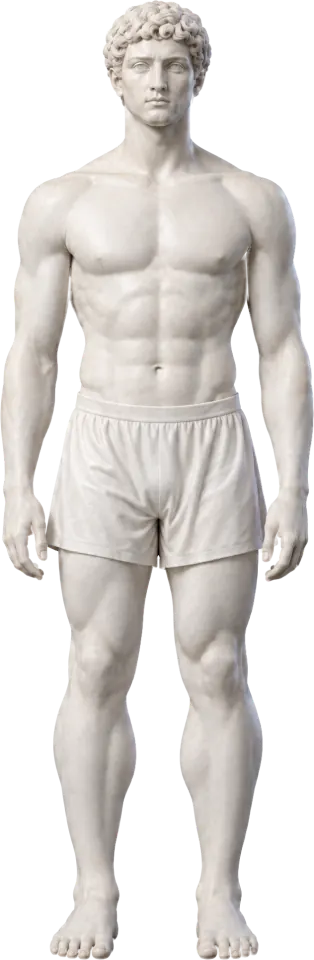
- 1Stand barefoot, feet hip-width apart, both pointing straight ahead.
- 2Press the big toe down without curling it, and lift the arch.
- 3Soften the knees and keep each one over the second toe.
- 4Close your eyes and hold it for 30 seconds.
What pulls is tight. Stretch it.
What shakes or can’t hold is weak. Strengthen it.
On this page, notice
- Bend the knees forward over the toes with the heels down. Where does it stop: the calf (tight) or the front of the ankle?
- Does the arch drop as the knee travels? That's the foot giving up range it can't hold.
The app · coming soon
Not sure which leak is yours?
The From the Feet Up app is a posture and movement scan for iPhone. Six standing photos, a squat, a lunge, a reach and a short walk, about five minutes. It reads five areas from the feet up and tells you what to fix first. Free for now.
Your photos are sent once for the read, never kept on our servers, and saved only on your phone.
Hear first when it launches.

Common questions
How long does it take to improve ankle mobility?
With daily work, many people gain noticeable range in a few weeks. Keeping it, with strength at the end of the range, usually takes a couple of months.
Is ankle mobility important for squats?
Very. Without it, the knee can't travel forward, so the heels lift, the feet turn out or the knees cave in to find depth.
Can stiff ankles cause knee pain?
They can contribute. When the ankle won't bend, the knee often twists or caves to make up the range. Checking the ankle is a good step when knees ache in squats or on stairs.
Why is one ankle stiffer than the other?
Often an old sprain, or years of leaning onto one side. It's common, and worth training the stiffer side a little more.
What is a good knee-to-wall distance?
Around a hand-width, about 10 cm or 4 inches, with the heel down is a common target. Matching your two sides matters as much as the number.
Educational, not a diagnosis or treatment plan. Sharp, severe, numb or worsening pain needs a qualified professional.