FOOT STRENGTHENING EXERCISES
Foot strengthening exercises: wake it up, load it, use it.
The best foot strengthening exercises train the big toe, the arch and the calf together. Start with big toe presses, toe spreads and short-foot arch lifts, then add slow calf raises and single-leg balance with the feet pointing straight. Do a few minutes daily, and carry it into walking. Strength builds over weeks.
By Muhammed Cam, founder · Updated
Where it starts · Shoes
Shoes turned your feet out.
These are the drills behind the first fix, feet forward. Shoes switched the foot off; these switch it back on.
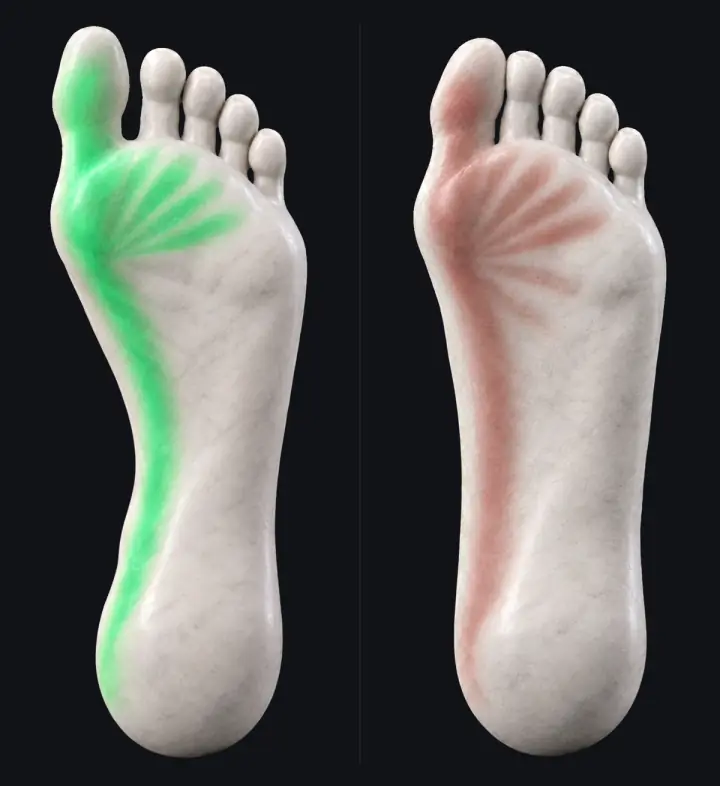
- Working
- Problem: tight or weak
The fix: Feet forward. Point them straight. Wake the arch.
Which foot exercises should I start with?
Stage one is waking the foot up. Barefoot, seated or standing, every day:
- Big toe press: press the big toe down while the other four lift. Then swap. 10 each.
- Toe spread: spread all five toes as wide as you can and hold for five seconds. 10 reps.
- Short foot: without curling the toes, draw the ball of the foot toward the heel so the arch lifts. Hold five seconds, 10 reps.
- Big toe walk-out: move the big toe away from the second toe, then press it down. 10 reps.
These feel awkward at first. Relearning to press the big toe down felt to me almost like relearning to walk. Stick with it.
How do I load the foot once it wakes up?
Stage two adds load, with the feet straight and the big toe pressing down on every rep:
- Slow calf raise: three seconds up, three seconds down, arch held. 2 sets of 12.
- Single-leg balance: 30 seconds a side, then try it with the eyes closed.
- Tibialis raise: back against a wall, lift the toes toward the shins. 2 sets of 15.
- Split squat: knee over the second toe, big toe heavy. 2 sets of 8 a side.
Calf raises and tibialis raises also build the ankle. The ankle mobility exercises guide pairs well with this stage.
How do foot exercises carry into walking and sport?
Stage three is using it. Drills only matter if they change how you stand, walk and play. Walk with the feet straight and push off the big toe. Spend time barefoot on grass or sand. Add skipping, then small hops, then sprints and sport.
If you want shoes that let the foot keep working, read barefoot shoes and foot strength before switching. Go slowly.
How often should I train my feet?
Little and often. Five to ten minutes a day beats an hour on Sunday. The arch and calf may feel worked for the first couple of weeks, like any muscle that's been asleep. Sharp pain, or soreness that lasts for days, means back off.
These exercises are one part of the bigger plan in how to fix your feet, which covers toe room and shoes as well.
A 60-second self-test
Feel it now
- 1Stand barefoot, feet hip-width apart, both pointing straight ahead.
- 2Press the big toe down without curling it, and lift the arch.
- 3Soften the knees and keep each one over the second toe.
- 4Close your eyes and hold it for 30 seconds.
What pulls is tight. Stretch it.
What shakes or can’t hold is weak. Strengthen it.
On this page, notice
- Can you press the big toe down without the other toes curling?
- With your eyes closed, which arch drops first? Start your drills on that side.
The app · coming soon
Not sure which leak is yours?
The From the Feet Up app is a posture and movement scan for iPhone. Six standing photos, a squat, a lunge, a reach and a short walk, about five minutes. It reads five areas from the feet up and tells you what to fix first. Free for now.
Your photos are sent once for the read, never kept on our servers, and saved only on your phone.
Hear first when it launches.

Common questions
How long does it take to strengthen your feet?
Most people feel a difference in a few weeks of daily practice. Real strength that holds through a full day, or a full match, usually takes a few months.
Can foot exercises fix flat feet?
They can often help a flexible flat foot work better, with a stronger arch and a more active big toe. They won't change bone structure, and painful or rigid flat feet should be checked by a professional.
Should foot exercises be done barefoot?
Yes, where you can. Being barefoot lets the toes spread and the foot feel the floor, which is the point of the exercise.
Why do my feet cramp during foot exercises?
Muscles that haven't worked in a while often cramp when they first switch on. Ease off, shake it out and do fewer reps for a while. If cramps keep coming back, get them checked.
Do I need equipment for foot exercises?
No. A wall and a step are enough. Toe spacers and a band are optional extras.
Educational, not a diagnosis or treatment plan. Sharp, severe, numb or worsening pain needs a qualified professional.