KNEE PAIN WHEN RUNNING
Knee pain when running: check how your foot lands.
Knee pain when running often comes from how the foot lands and pushes. If the foot turns out and the arch drops on landing, the knee caves in over it, thousands of times a run. Point the feet straight, land under the hips, keep the knee over the second toe, and build mileage slowly while the feet catch up.
By Muhammed Cam, founder · Updated
Where it starts · Shoes
Shoes turned your feet out.
Running shows the first leak more than anything. On the right, the planted foot turns out and the strain lands on the inside of the knee. That's thousands of landings a run on a knee that's off line.
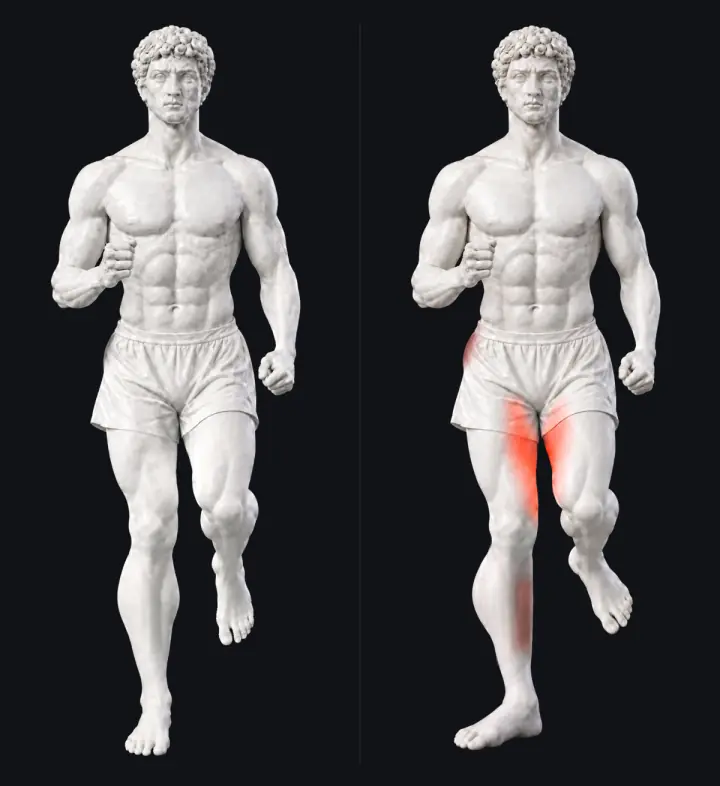
- Working
- Problem: tight or weak
The fix: Feet forward. Point them straight. Wake the arch.
Why do my knees hurt when I run but not when I walk?
Running multiplies everything. Each landing carries more force than a step, and a run is thousands of landings in a row. A small habit that walking hides, a foot that turns out or an arch that drops, gets repeated under load until the knee notices.
That's why sprinters show the receipt. At speed there's nowhere to hide a leak. A runner's knee is the same idea at a slower pace.
What should my feet do when I run?
Point forward, land under the hips rather than out in front, and push off through the big toe. With the feet straight and the arch working, each stride can spiral from the arch through the opposite glute to the opposite shoulder, and the knee stays a simple hinge in the middle.
With the feet turned out, the knee swings out, then caves over the arch as you land. If that sounds like you, start with the duck feet guide before you change anything else.
Do I need new running shoes?
Maybe, but shoes rarely solve it alone. A worn-out shoe can be worth replacing. Heavily cushioned, narrow shoes can feel comfortable while letting the foot switch off. Wider, flatter shoes give the toes room to work, but switching quickly can overload calves and arches that aren't ready.
If you're thinking about minimalist running shoes, read barefoot shoes and foot strength first. The shoe is a tool. The foot still has to do the work.
How do I change my running without getting hurt?
Change one thing at a time, and change the body more than the stride:
- Cut the distance back if pain changes how you run. Limping miles teach new leaks.
- Add a few short form drills before runs: feet straight, quick light steps, push off the big toe.
- A slightly quicker step rate often keeps the landing under the hips.
- Twice a week, train single-leg strength: split squats, step-ups and calf raises with the big toe down.
- Build mileage slowly, by about a tenth a week at most.
If the knee hurts outside running too, read the main knee pain guide, and check your ankles with the ankle mobility exercises guide.
A 60-second self-test
Feel it now
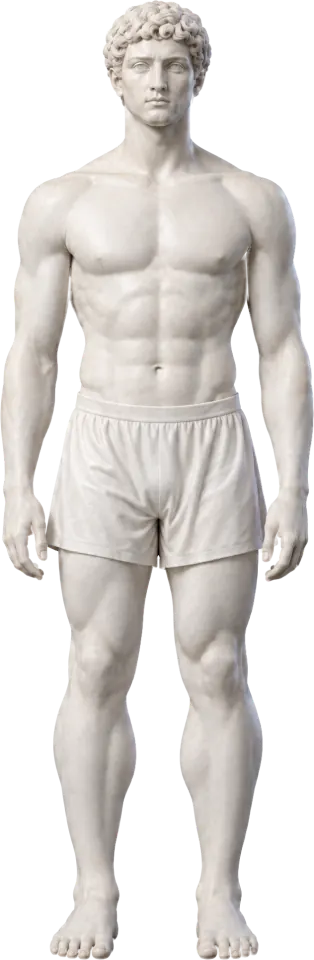
- 1Stand barefoot, feet hip-width apart, both pointing straight ahead.
- 2Press the big toe down without curling it, and lift the arch.
- 3Soften the knees and keep each one over the second toe.
- 4Close your eyes and hold it for 30 seconds.
What pulls is tight. Stretch it.
What shakes or can’t hold is weak. Strengthen it.
On this page, notice
- Shift onto one foot, as if mid-stride. Does the arch hold, or does it drop and pull the knee in?
- Notice which side feels steadier. Most runners have one.
The app · coming soon
Not sure which leak is yours?
The From the Feet Up app is a posture and movement scan for iPhone. Six standing photos, a squat, a lunge, a reach and a short walk, about five minutes. It reads five areas from the feet up and tells you what to fix first. Free for now.
Your photos are sent once for the read, never kept on our servers, and saved only on your phone.
Hear first when it launches.

Common questions
Should I keep running with knee pain?
If it's a mild ache that doesn't change how you run, easing back on distance while you work on strength is often fine. If it's sharp, swollen or makes you limp, stop and get it checked.
Can running shoes cause knee pain?
Shoes can play a part, for example a worn-out pair or a sudden switch to a very different shoe. They're rarely the whole story. Foot position, strength and mileage matter as much.
Does running form affect knee pain?
It can. Landing far in front of the hips, feet turning out and knees caving in all add load to the knee. Small changes, made slowly, can often help.
What exercises help runners' knees?
Single-leg work like split squats and step-ups, side glute work, calf raises with the big toe pressing down, and foot strength. Keep each knee over the second toe on every rep.
Is knee pain after running normal?
Mild muscle soreness after a hard run is normal. Joint pain that keeps coming back after runs isn't something to just accept, and it's worth looking at how you land.
Educational, not a diagnosis or treatment plan. Sharp, severe, numb or worsening pain needs a qualified professional.