LOWER BACK PAIN FROM SITTING
Why does my lower back hurt after sitting?
Sitting keeps the hip flexors short and switches the glutes off. When you stand up, the tight front of the hip pulls the pelvis forward and the lower back arches to hold you upright, so it aches. Stack the pelvis: glutes back on, hip flexors long, feet pointing straight, and get out of the chair often.
By Muhammed Cam, founder · Updated
Where it starts · Sitting
Sitting switched your glutes off.
This is the second leak. Hours in a chair switch the glutes off and tip the pelvis forward, and the lower back takes over the job of holding you up.
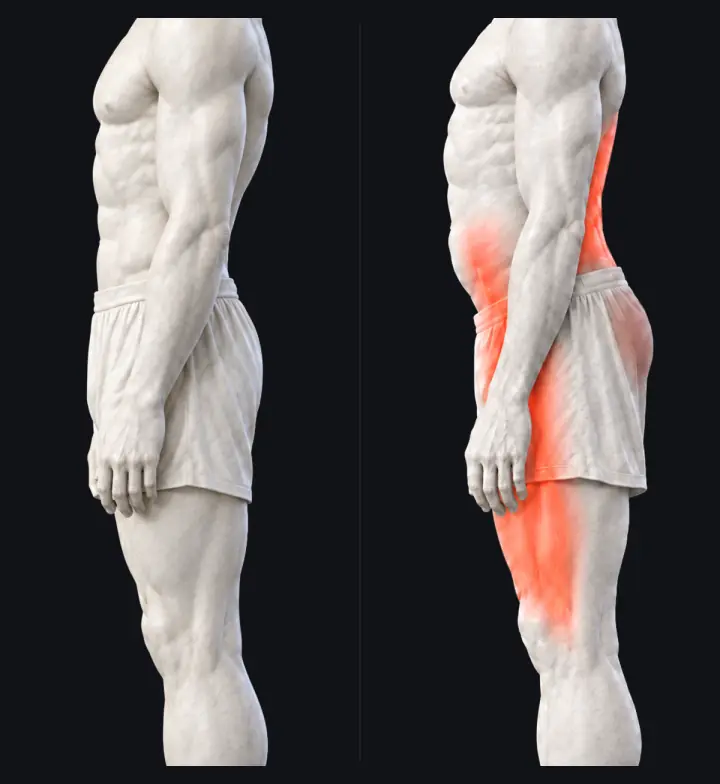
- Working
- Problem: tight or weak
The fix: Stack the pelvis. Glutes back on. The best athletes have big ones.
What does sitting do to the hips and back?
When you sit, the hip flexors at the front of the hip stay shortened, the glutes are squashed and idle, and the abs have nothing to do. One hour of that is nothing. Eight hours a day, five days a week, and the body starts to treat it as normal: the front gets tight, the back of the hip gets lazy.
Then you stand up. The tight hip flexors don't let go straight away, so they pull the front of the pelvis down. The lower back arches to keep you balanced, and because the glutes are still asleep, the small muscles along the spine do the holding.
Why does it hurt most when I first stand up?
That first stiff walk to the kitchen is the moment the pelvis has to switch from chair shape to standing shape. If the glutes can't fire quickly, the back braces instead. It often eases after a few minutes of walking, which is a clue that it's about position and muscles waking up rather than damage.
If your glutes take a while to show up for work, the guide to glutes switched off from sitting has a simple check and the exercises that help them switch on again.
Is a better chair or a standing desk enough?
A good chair can make sitting more comfortable, and a standing desk gives you another position. Both help. Neither switches the glutes back on. Standing all day with the pelvis tipped and the feet turned out can load the lower back in much the same way.
The best position is the next one. Change it often, and when you stand, stand stacked: feet straight, big toe down, belt line level, ribs over the pelvis. If your pelvis sits tipped forward even when you stand, read the anterior pelvic tilt guide.
What can I do at my desk?
Small, frequent resets beat one long session at the end of the day. Every 30 to 45 minutes:
- Stand up, point the feet straight and press both big toes down.
- Squeeze the glutes for five seconds and let the belt line level out.
- Take a half-kneeling hip flexor stretch for 30 seconds a side, glute squeezed on the kneeling side.
- Walk for two minutes, pushing off the big toe.
If your back aches in other places too, or not only after sitting, start with the wider guide to back pain.
A 60-second self-test
Feel it now
- 1Stand barefoot, feet hip-width apart, both pointing straight ahead.
- 2Press the big toe down without curling it, and lift the arch.
- 3Soften the knees and keep each one over the second toe.
- 4Close your eyes and hold it for 30 seconds.
What pulls is tight. Stretch it.
What shakes or can’t hold is weak. Strengthen it.
On this page, notice
- Try it straight after a long sit, before you walk around.
- If the front of the hips pulls as you stand tall, the hip flexors are tight. If one glute can't hold a squeeze, it's weak.
The app · coming soon
Not sure which leak is yours?
The From the Feet Up app is a posture and movement scan for iPhone. Six standing photos, a squat, a lunge, a reach and a short walk, about five minutes. It reads five areas from the feet up and tells you what to fix first. Free for now.
Your photos are sent once for the read, never kept on our servers, and saved only on your phone.
Hear first when it launches.

Common questions
Why does my lower back hurt after sitting but not when I walk?
Walking gets the glutes working and lets the hip flexors lengthen, so the lower back can relax. Sitting does the opposite. Pain that eases as you move often points at position and muscle habits rather than an injury, though a professional should check pain that persists.
Is sitting bad for your lower back?
Sitting itself isn't harmful, but long, unbroken sitting can tighten the hip flexors and switch the glutes off. The fix is less about the perfect chair and more about getting up often and keeping the glutes and hips working.
What is the best sitting position for lower back pain?
Feet flat and pointing forward, hips slightly higher than the knees, and the weight on the sit bones rather than the tailbone. Then change position often. Any position held for hours can ache.
Does a standing desk help lower back pain?
It can, mainly because it lets you switch positions. Standing with the pelvis tipped and the feet turned out can still load the lower back, so stand stacked and keep moving.
How often should I get up from my desk?
Every 30 to 45 minutes is a good rule. Even a minute of standing, a glute squeeze and a short walk can help the hips reset before they stiffen.
Educational, not a diagnosis or treatment plan. Sharp, severe, numb or worsening pain needs a qualified professional.